
June 17, 2026

Here is some framemaking and some term defining that will help me build a worldview and say other things down the road.
What is cognition?
Cognition is the process by which I (agent) come to know the world (arena).
When I use the word cognition I am not talking about a mental calculation that occurs somewhere outside of a body. I am talking about the process of coming to know world that happens in and through and by means of the lived body. It is both top-down and bottom-up.
Our human cognition shapes (and is shaped by) our thinking, our problem solving, our inner world, our intuiting, our art, our loving, our becoming, our sense of meaning in the world.
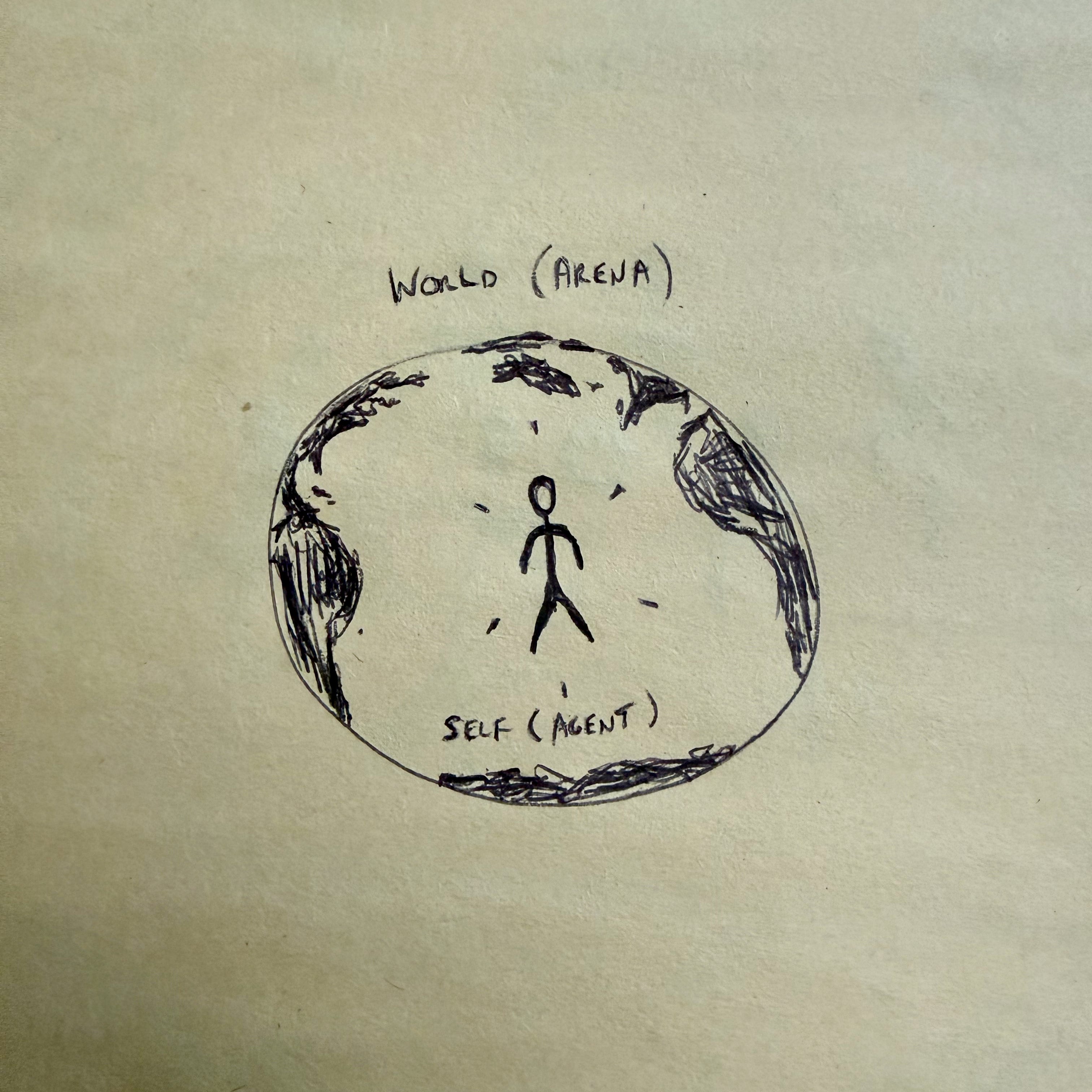
What is knowing made of?
John Vervaeke (a 4E cognitive scientist and philosopher I consider to be a dear teacher1) describes a model with four kinds of knowing:
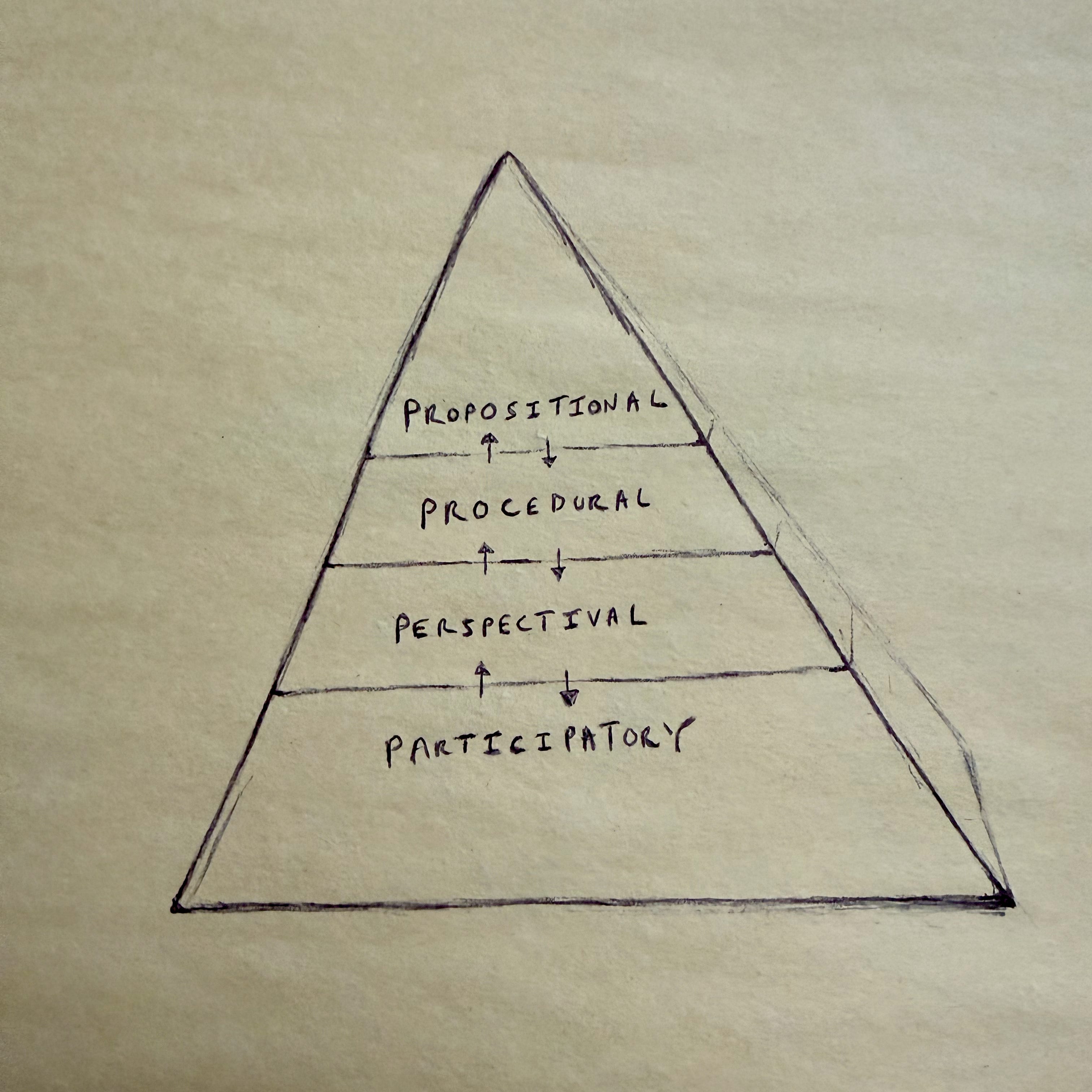
There is propositional knowing. This is knowing that something is true. The knowing of facts and beliefs. I know that blueberries are a fruit.
There is procedural knowing. This is knowing how. The knowing of skills. I know how to brush my teeth.
There is perspectival knowing. This is knowing what it’s like to be here, now. The knowing of a particular vantage point, a particular way of seeing. I know what it’s like to see the world as a human.
And there is participatory knowing. This is the knowing of relationship - with self, with other, with world. The knowing born of connectedness. I know what it’s like to be an organism in an ecosystem, a node in a network.
The model can be thought of something like a pyramid, with participatory knowing as the bottom layer. Each layer is the precondition that makes each layer above it possible.
If I wasn’t an agent embedded in an arena, how could I possibly take up a certain perspective? And if I couldn’t be situated in context with a particular view, how could I learn or apply any particular skill? And without the capacity to act, classify, discern, how could I know any particular fact to be true or false?
While the bottom layers make layers above possible, there is multi-directional influence. For instance, how I see the world (perspectival knowing) affects what I believe to be true (propositional knowing), and what I believe to be true affects how I see the world.
John describes our present world as one that largely lives under propositional tyranny, a state of affairs wherein the knowing of facts and beliefs is seen as the primary or only way of knowing. (Interestingly, this view (perspectival knowing!) is reflected in the common flattening of the word cognition (propositional knowing!) into a mere mental process.)
In the devaluing of and disconnection from non-propositional knowing, we find ourselves facing a crisis of cognition and meaning.
4E cognitive science is a branch of cognitive science which holds that cognition is embodied, extended, enacted, and embedded. This field, and John Vervaeke’s contributions within it, has been highly influential in my understanding myself and the world. I will continue to be in dialogue with this body of work as we go along.